Trades and home services
Landscaping, garden maintenance and pool servicing. Recurring visits with customer time windows, technicians with the right skills or equipment, shift end times and breaks.
Operating Model
Software as a Service (SaaS)
Your customers schedule services, repairs, deliveries and collections in your software, then plan the day's driving by hand. The Tarot Optimisation Engine adds route optimisation to your platform through an API, priced per address optimised.
Route planning is the step straight after the booking, so your customers expect it in the same place. While it isn't there, they plan on a whiteboard or in a spreadsheet, or pay for a separate tool. A competitor that does both starts to look attractive.
Building it yourself is a bigger project than it looks. Vehicle routing is a specialist optimisation problem, and the optimiser needs ongoing work as your customers find cases you didn't plan for. That's a permanent commitment for one feature, competing with your core product for roadmap space. The Optimisation Engine is that optimiser, built and maintained by Tarot, so your team stays on your product.
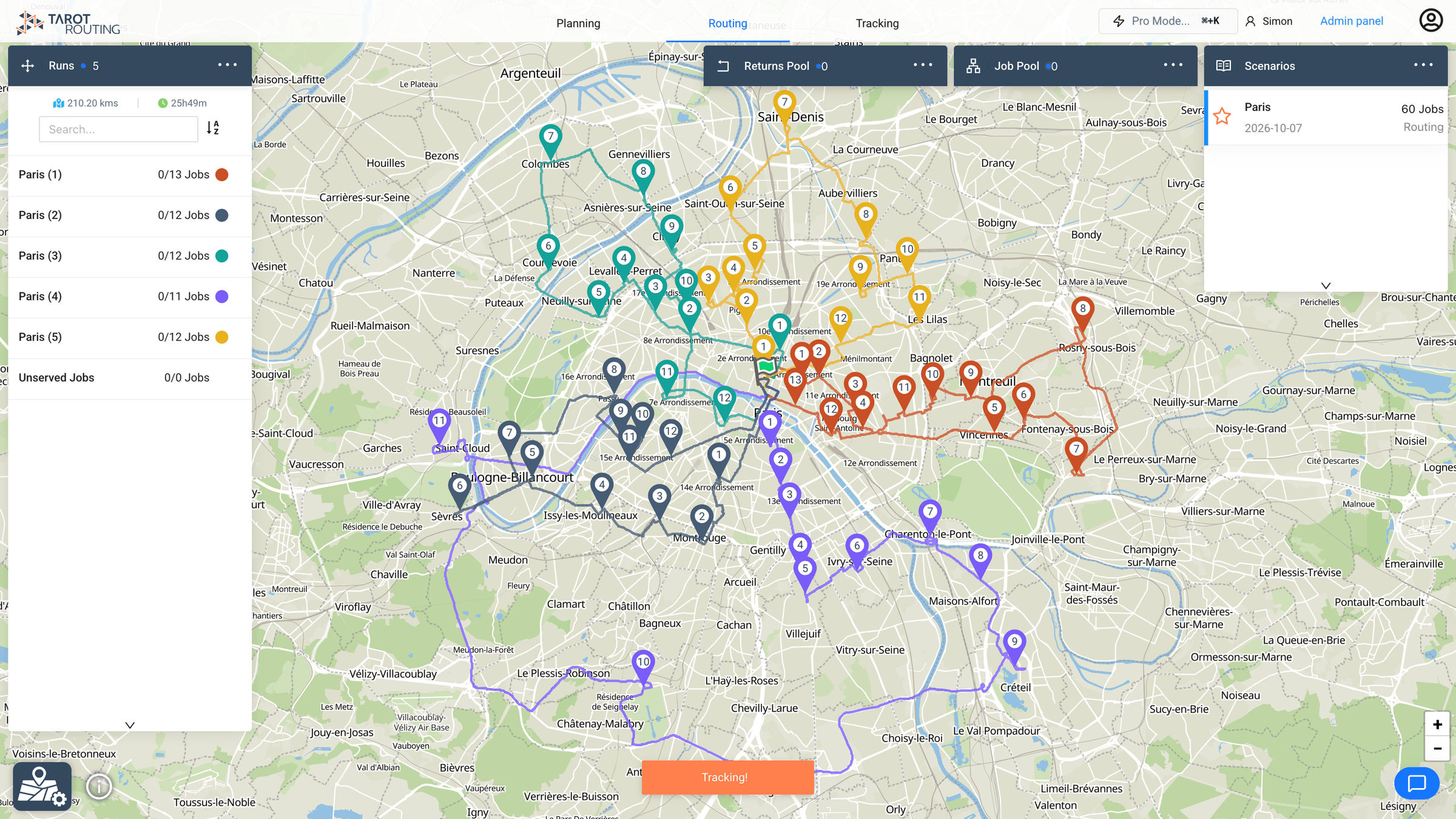
The optimiser handles the constraints service businesses work with every day, so routes are plans your customers can actually run. If your customers send people or vehicles to addresses on a schedule, the same API applies.
Landscaping, garden maintenance and pool servicing. Recurring visits with customer time windows, technicians with the right skills or equipment, shift end times and breaks.
Collect bikes for servicing and return them, or deliver and collect rentals, on the same run. Vehicle capacity can reflect a reconfigurable van, such as 4 pallets and 1 bike, or 1 pallet and 8 bikes.
Deliveries and collections on the same route, capacity in more than one dimension such as weight and pallets, and jobs restricted to vehicles with a tail lift.
Per-vehicle routing software is priced for companies whose business is delivery. The Optimisation Engine is priced for software companies that want to offer routing as one feature among many.
You pay for the addresses your customers optimise, so the cost follows how much the feature is used.
Include route optimisation in a plan, sell it as an add-on, or pass the cost through. The pricing model is yours to choose.
Optimised routes come back to your system and appear in your own interface. Your customers never need a Tarot account.
Send your jobs, vehicles, depots and constraints to the Optimisation API. It returns each vehicle's route, with the job order and arrival times, ready to store and display.
The API supports time windows, vehicle capacity, driver shifts and breaks, skills and vehicle types, pickup and delivery, priority jobs, territories and typical traffic for the time of day. Optimise for time, distance or cost, and re-optimise when the day changes.
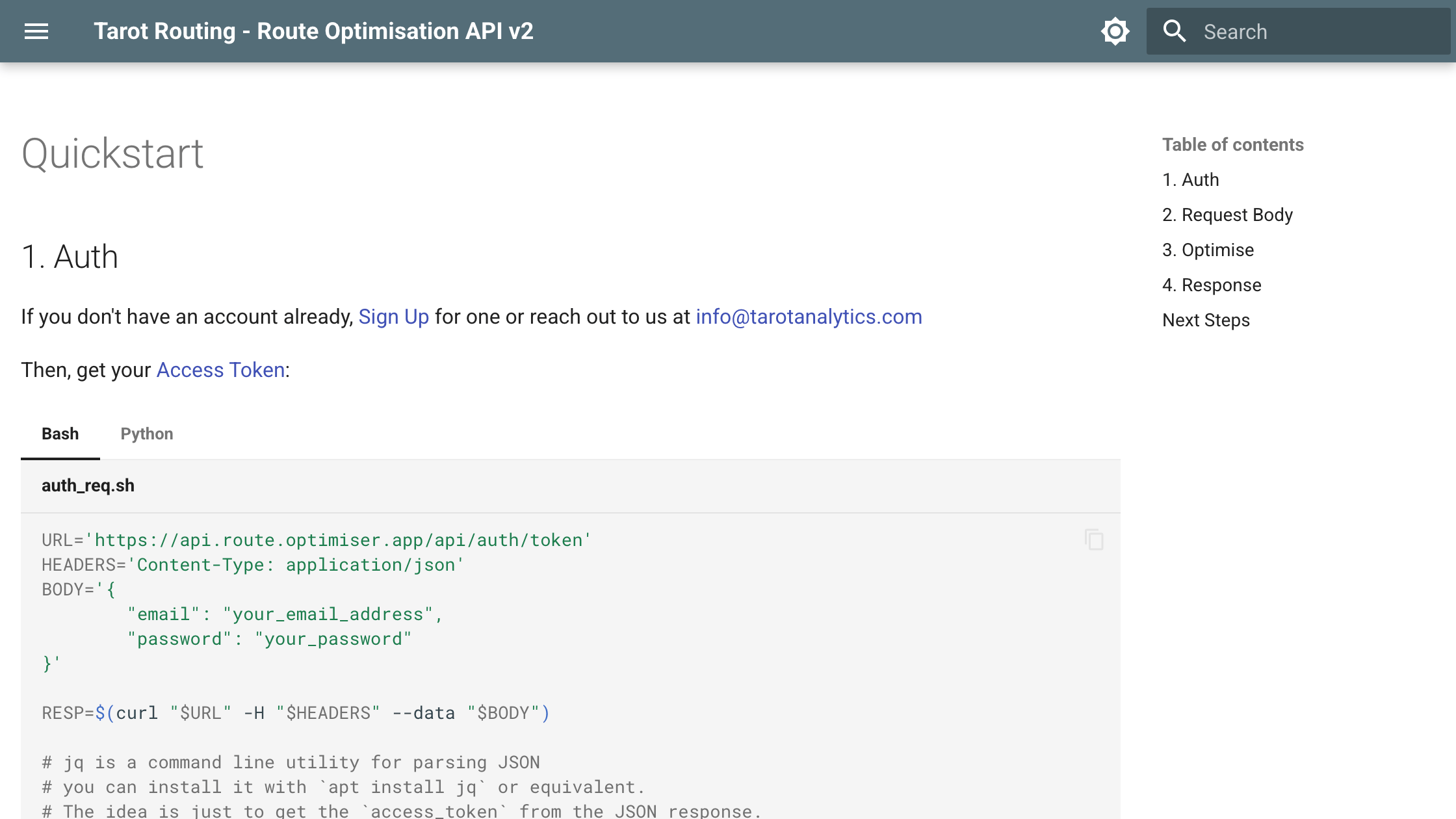
No. Your platform calls the Optimisation API and shows the optimised routes in your own interface. Your customers work in your software and never need to sign in to Tarot.
Per address optimised, with no per-vehicle subscription. The cost follows how much your customers use route optimisation, which suits a feature that some customers use every day and others only occasionally. Current prices are on the pricing page.
Time windows, exclusion windows, vehicle capacity in one or more dimensions, driver shifts and breaks, separate start and end locations, skills and vehicle types, pickup and delivery, priority jobs, territories and typical traffic for the time of day. You choose whether to optimise for time, distance or cost. The developer docs cover each constraint with examples.
Those are part of the Tarot Routing platform on the Business and Enterprise plans, which include the Platform API for connecting it to your software. Book a demo and we'll work out which fits your platform.